The system pulls call recordings from the phone system, transcribes each conversation, scores reps on four criteria, and exports the results to a Google Sheet every day

Intellekt Razvitie is a systems integrator that rolls out automation and AI for its clients. For one of them — an insurance company with a telesales team — it hired us to build a system that checks call quality.
In phone sales, everything hinges on the conversation: how the rep uncovers the customer’s needs, handles objections, and secures the next step. To stay on top of those conversations, a supervisor listens to recordings and scores every rep.
Listening took three to five hours a day, and coverage stayed low: only 5–15% of calls were reviewed manually. Scores were subjective — different reviewers judged the same situation differently. There was no single spreadsheet with each rep’s history, and reps got feedback only a few days later.
By the time a call came up for review, the rep had already repeated the mistake, and as the team grew, manual QA could no longer keep up with call volume.
Off-the-shelf tools didn’t fit: they didn’t integrate with the company’s phone system, Beeline’s cloud PBX, and couldn’t be tailored to the client’s sales methodology. The client needed a system that collects recordings, scores conversations against the company’s own rules, and hands the supervisor a ready-made report.
The supervisor no longer downloads recordings or listens to calls: every call that qualifies for scoring gets checked, not just a sample.
The criteria follow the company’s sales methodology, so every rep is scored by the same rules, not by an individual reviewer’s opinion.
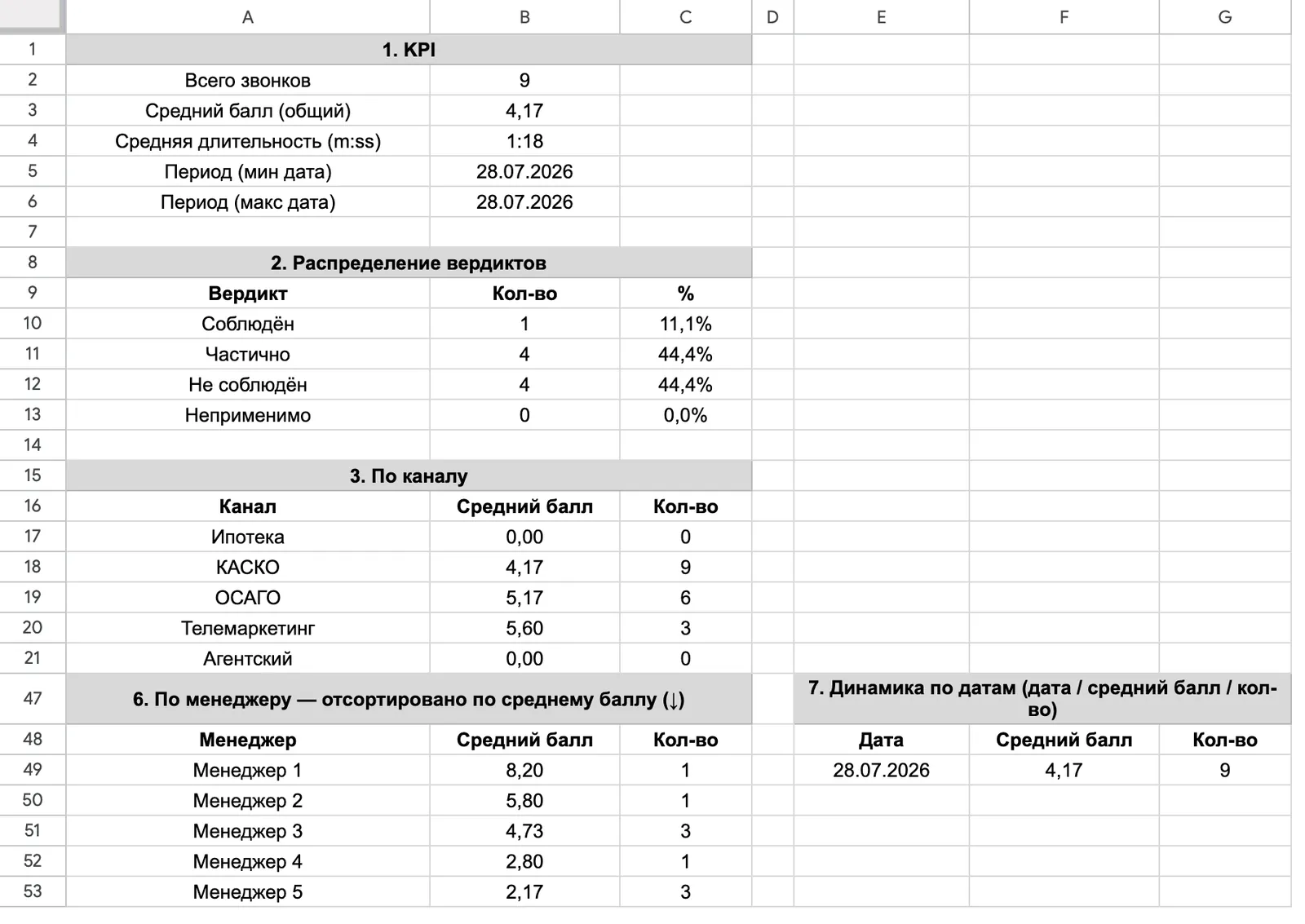
Scores for every call from every rep live in one Google Sheet, and the “Summary” tab shows each rep’s average score.
A new report comes out every day, so the supervisor can see right away who needs coaching and on what.
Here’s how a single call moves through the system, from the recording to a row in the report.
On a set schedule, the system queries the Beeline cloud PBX API, pulls the list of newly completed calls, and downloads the recordings. Calls below a minimum length and calls with no speech are filtered out right away — there’s nothing to score.
The recording is transcribed and split into the rep’s lines and the customer’s lines. Speakers are identified by what they say, so the system tells them apart in calls from both the direct and agent sales channels. Thanks to that split, only the rep’s words get scored: their questions, objection handling, and what they agreed on.
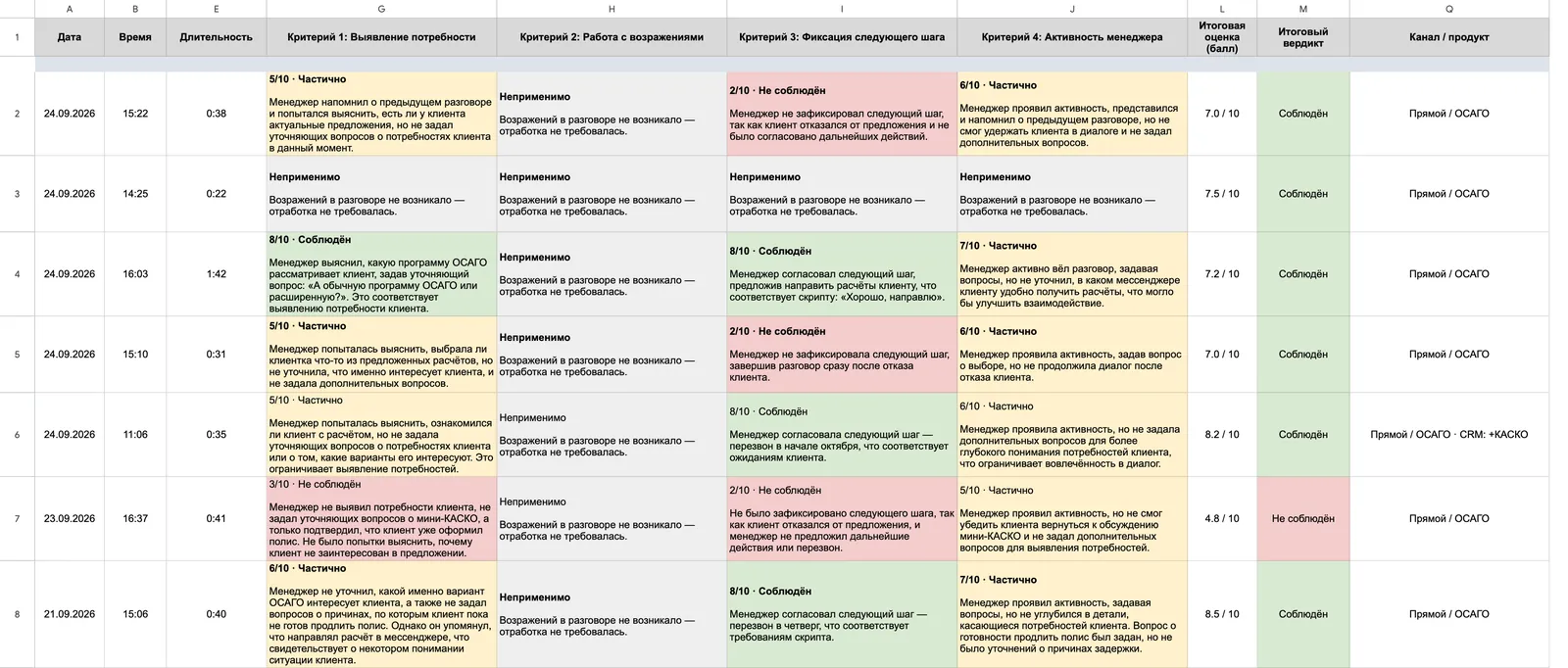
A language model checks the conversation against the criteria: whether the rep uncovered the need, how they handled objections, whether they secured a next step, and how actively they drove the call. It scores each item with a short explanation, and the system calculates the total score and issues a verdict. On top of the four core criteria, each product — OSAGO (mandatory auto liability insurance), CASCO (comprehensive auto insurance), and mortgage insurance — has its own checklist based on the company’s methodology.
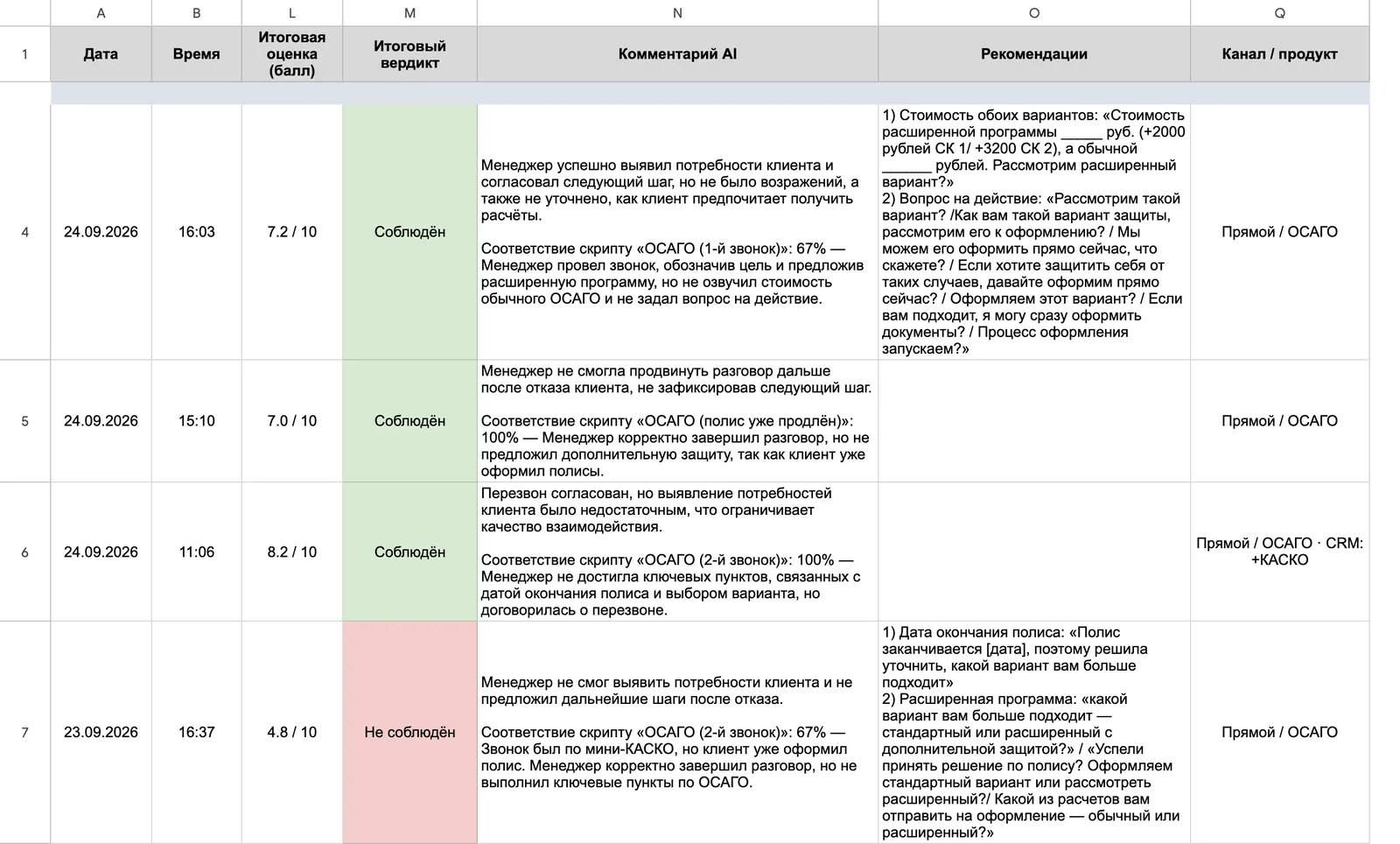
Results go to a Google Sheet, one row per call: rep, date, scores by criterion, total score, and comment.
Also used: PostgreSQL — call and score storage · APScheduler — job scheduling · Docker — server deployment
The supervisor no longer listens to calls by hand: the system scores every conversation automatically, and results for every rep live in one spreadsheet.
A similar system fits any business where customer conversations drive revenue directly and there are simply too many to review by hand.
We build solutions like this around your needs: turnkey AI products, AI agents and automation, integrations, and data.
Our servicesTell us about your project — we’ll talk it through and show you how to make this work for your business

We use cookies and Yandex Metrica to improve our website. Privacy policy